
What Is the A-Game Framework?
The A-Game Framework is a complete system for mastery—not just in martial arts, but in life.
The A-Game isn't a secret technique or a shortcut. It's a philosophy about how skill actually develops. It says: mastery isn't a destination you reach at Black Belt. It's a spiral you climb continuously, at every level, using the same four pillars. Foundation. Systems. Execution. Diagnostics. Every time you test for a new belt, you're not leaving these pillars behind—you're deepening them.
Most martial arts programs treat belt levels as linear progression: white → blue → purple → brown → black, done. The A-Game sees it differently. Every belt level cycles through the same four pillars. A White Belt learns Foundation. A Black Belt perfects Foundation. The difference is depth, not novelty.
Why It Matters
Because it changes how you approach training. You stop chasing the next belt. You start chasing mastery. And mastery isn't a peak; it's a career-long spiral. The best grapplers are comfortable returning to basics. They know Foundation is permanent.
The Four Pillars
Every belt level—from Gray Belt kids to Black Belt adults—cycles through these four pillars. They're not phases you graduate out of. They're the architecture of skill at every level.
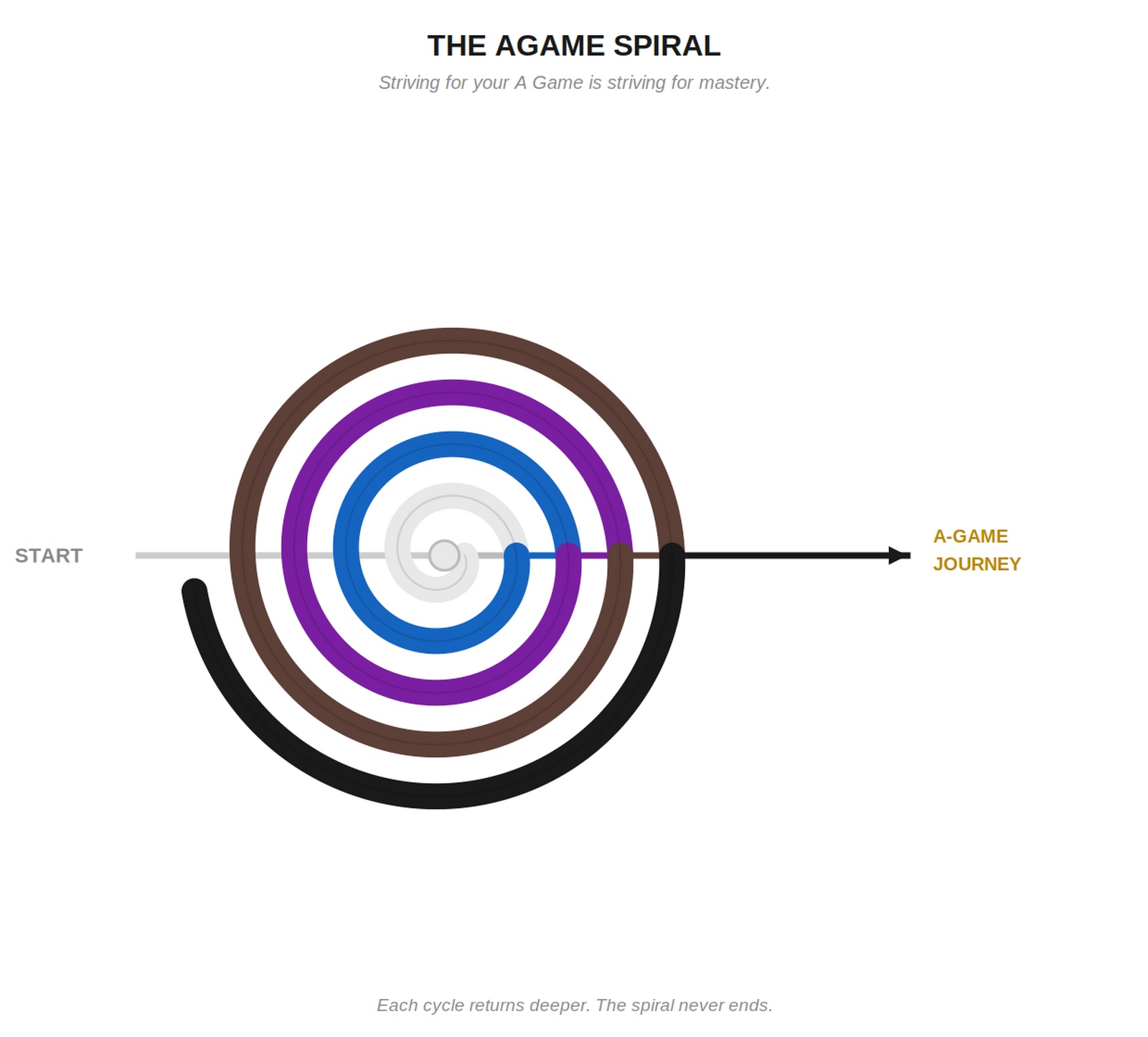
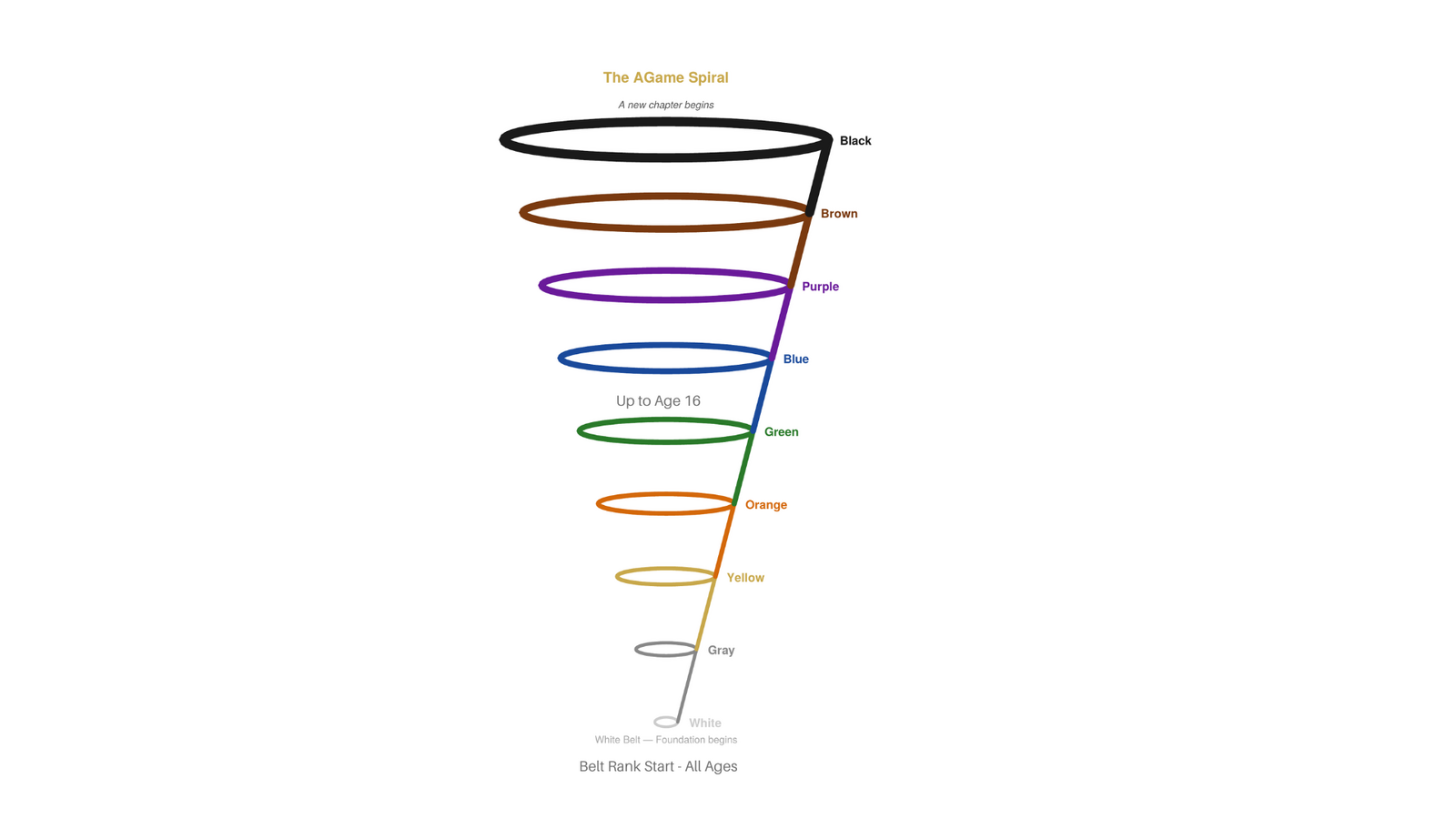
The A-Game Spiral
As you advance, the spiral doesn't flatten. It deepens. Every revolution brings you back to the same pillars, but at a higher level of mastery.
Pillar 1: Foundation
The skills that never go away. Basic position. Basic movement. Basic breathing. A White Belt learns the scissor sweep in Week 3. A Black Belt teaches it the same way—but with invisible layers of understanding that come from thousands of reps.
Why it matters: Depth comes from repetition, not novelty. The best athletes are comfortable with simplicity.
At White Belt: You learn basic positions. Move with control. Breathe deliberately. Get the technique once. Survive.
At Black Belt: You perfect basic positions. Teach with precision. Breathe to control your nervous system. Understand invisible timing. Dominate.
The insight: The difference between White and Black isn't more techniques. It's deeper understanding of the fundamentals. A Black Belt teaches the scissor sweep the same way—but they understand 50 variations, 100 timing adjustments, the exact pressure needed. That's Foundation mastery.
Pillar 2: Systems
Systems is where individual techniques become strategy. You learn how one move opens the next, how sequences chain, how you read and respond to resistance.
At White Belt: Techniques connect (sweep → pass → submit). You see how one move opens the next. You're building the mental map.
At Black Belt: Everything connects to everything. Position feeds offense feeds defense feeds positioning. You see the web instantly. You move through it like breathing.
The insight: A white belt follows a sequence: "If they do X, I do Y, then Z." A black belt sees patterns: "They're committed to this defense, so they're vulnerable here." Systems is learning to read the game.
Pillar 3: Execution
Execution is where technique meets resistance. In Foundation and Systems, partners cooperate. In Execution, they push back. Can you land it when someone actively defends?
At White Belt: Technique works against passive resistance. You're building the movement pattern. Confidence grows.
At Black Belt: Technique works against elite resistance, in high-stress conditions, in competition. It's automatic. You don't think—you execute.
The insight: Knowledge is reading a manual. Execution is doing the work when it matters. That's where real skill lives.
Pillar 4: Diagnostics
Diagnostics is asking: "Why didn't that work?" You identify what went wrong and fix it immediately. Not all positions feel the same twice—Diagnostics lets you adjust in real time.
At White Belt: You notice when something doesn't work. Coach points it out. You're learning to see.
At Black Belt: You diagnose and adapt mid-roll. Noise becomes signal. You know instantly what will work this time.
The insight: A beginner follows a plan and hopes it works. A master reads the roll and adapts. Diagnostics is the difference.
The Five Skills: SURVIVE, DEFEND, ESCAPE, CONTROL, SUBMIT
Within the four pillars, you develop five core skills. Understanding where you sit on each skill scale is your personal roadmap.
What Each Skill Means
SURVIVE: Handle immediate tap threats (strangleholds, joint locks, acute pressure). Stay safe. First priority in danger.
DEFEND: Deny positional advancement before it becomes a tap threat. Prevention beats reaction.
ESCAPE: Get out of a bad position and return to neutral. Work your way back into the game.
CONTROL: Hold position without expending energy. Dictate pace and pressure. Set the tone.
SUBMIT: Finish from dominant position. End the round on your terms.
How Skills Scale by Belt
Each skill has a 1-10 scale of competency. Here's how they scale as you advance:
| Belt | SURVIVE | DEFEND | ESCAPE | CONTROL | SUBMIT |
|---|---|---|---|---|---|
| White | 5/10 vs higher level | 3/10 vs same level | 2/10 vs same level | 5/10 vs lower level | 3/10 vs lower level |
| Blue | 6/10 vs higher level | 5/10 vs same level | 5/10 vs same level | 7/10 vs lower level | 5/10 vs lower level |
| Purple | 7/10 vs higher level | 6/10 vs higher level | 6/10 vs same level | 8/10 vs same level | 7/10 vs same level |
| Brown | 8/10 vs higher level | 7/10 vs higher level | 7/10 vs higher level | 9/10 vs same level | 8/10 vs same level |
| Black | 9/10 vs same levels | 9/10 vs same level | 9/10 vs same level | 9/10 vs same level | 9/10 vs same level |
Key insight: Mastery doesn't mean 100%. It means 7/10 threshold: a skill that shifts match outcomes in your favor more often than not. That's reliable. That's real.
The Core Mindsets Behind A-Game
1. "Mat skills are life skills"
The principles you learn on the mat: showing up, working hard, failing forward, adapting, don't stay on the mat. They follow you into work, relationships, how you handle adversity. A-Game is as much about life as it is about grappling.
2. "Mastery = career average across thousands of rounds, not perfection"
You will have bad rolls. You will forget techniques. You will feel lost. That's part of the path. The 7/10 threshold is real: if a technique works in your favor more often than not, you've internalized it. Perfection is unnecessary. Consistency is everything.
3. "The 7/10 threshold: a skill that shifts match outcomes in your favor more often than not"
Mastery doesn't mean 100%. It means the scissor sweep works 7 out of 10 times, the armbar finish is reliable 7 out of 10 times, your escape happens 7 out of 10 times. That's enough. That's real. That's what separates talk from action.
4. "Practice makes habits"
Repetition is sacred. The skill you work on becomes automatic. That automation is what frees your mind to adapt, to think, to compete. Habits are the foundation of execution.
5. "Foundation is permanent"
You never graduate from basics. The best grapplers return to fundamentals constantly. A-Game says: don't chase advanced techniques. Chase mastery of the fundamentals. Everything else is built on that base.
6. "Effectiveness is a scale"
When we learn anything, it just needs to work consistently. Over time we make it cleaner, more crisp, with less effort and time. This is the foundation of skill acquisition and moving from effective skills to efficient ones.
How A-Game Is Different
Most martial arts programs are linear. A-Game is cyclical—a spiral where you return to the same pillars at every level, going deeper each time.
| Traditional Approach | A-Game Approach |
|---|---|
| Linear progression (white → blue → ... → black) | Spiral progression (same four pillars, deeper each level) |
| Foundation is a beginner phase; graduate out | Foundation is permanent; return to it always |
| Techniques in isolation (learn armbar, learn triangle, etc.) | Techniques connected in sequences (how they chain, how to read responses) |
| Cooperative practice, then pressure | All four pillars active at every level; intensity increases, not structure |
| Belt promotion = achievement; move on | Belt promotion = starting point at deeper level |
| Goal: get to black belt | Goal: master the framework at every level |
A-Game Off the Mat: Life is a Battle
Life is a Battle. Become Battle Ready. On the mat, the four pillars teach you to grapple. Off the mat, they teach you how to live.
Foundation in Life
Show up. Do the work. Master the basics of your craft. Don't skip steps. In business, relationships, any domain: foundation is everything. You don't skip to advanced strategy when you haven't mastered the fundamentals.
Systems in Life
Understand how things connect. One career move opens the next. One relationship decision cascades. Systems thinking helps you see patterns and prepare for what's coming next.
Execution in Life
It's not enough to know what to do. You have to do it when it matters, when stress is high, when the outcome is real, when someone is pushing back. Execution is the difference between theory and action.
Diagnostics in Life
When something doesn't work, ask why. Diagnose the problem. Adapt. Don't repeat the same mistake. Every failure is data if you're paying attention.
Ready to Train Your A-Game?
Get started today. It is NEVER too late to improve.
I'm readyFREE TRIAL PASS
Thank you! A Coach will be in contact with you shortly!
90 Day Special
Thank you! One of our Coaches will be in contact with you!